
General · 14 min read
Stun Gun Laws By State: Are You Legal?
Stun gun <a href="https://cheetahstunguns.com/2026/07/09/florida-stun-gun-laws-is-it-legal-to-carry-in-2026-updated-guide/">laws by state</a> are far from uniform, which creates a real legal minefield...
By Cheetah Stun Gun - Admin
Stun gun laws by state are far from uniform, which creates a real legal minefield for anyone who carries an electronic self-defense device across state lines. While the federal government leaves general possession up to the states, individual state codes range from fully permissive to heavily restricted, making it essential to know the specific rules where you live and where you travel.
Stun guns are handheld devices that deliver an electric shock to temporarily incapacitate an attacker. They are often confused with tasers, but the two operate differently: a stun gun requires direct contact with the target, while a taser launches projectile probes. This technical distinction matters because some state statutes treat them separately.
This article provides a clear framework for understanding the legal possession, carry, and use of stun guns across the United States. Because state laws change frequently, always verify the current statute with an official state source or a licensed attorney before relying on any information here.
Key Takeaways
- Stun guns are legal in most states, but restrictions on open carry, concealed carry, and specific locations vary significantly.
- Some states require a permit or license to carry a stun gun, while others treat them like firearms for certain purposes under their criminal code.
- Federal law prohibits possession on aircraft and in certain federal buildings, regardless of state law.
- Age restrictions (typically 18 or 21) exist in many states, but the exact threshold varies by jurisdiction.
- Self-defense use is generally permitted, but "brandishing" or "threatening" with a stun gun can be charged as a crime in some states.
The Complete Answer: What Are Stun Gun Laws by State?
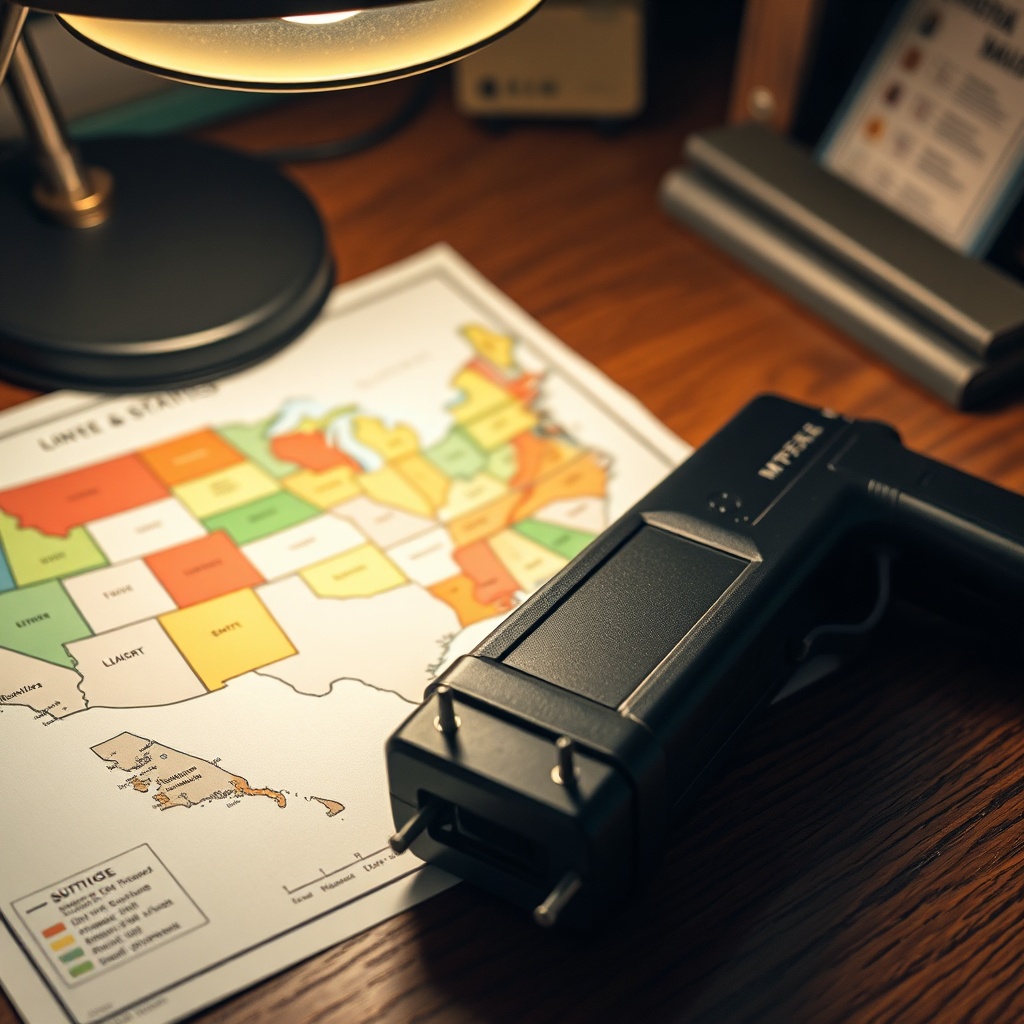
A visual metaphor for the complex patchwork of state regulations, showing a stun gun alongside a map highlighting legal differences.
The most direct answer to the question of stun gun laws by state is that the majority of states allow adults to possess and carry stun guns without a permit. However, this is not a universal rule. A minority of states require a concealed carry permit, and a small number impose outright bans or severe restrictions that limit possession to law enforcement officers.
Quick Answer: Most U.S. states allow legal possession of stun guns for adults without a permit, but a handful require a concealed carry license, and a few restrict or ban them entirely. Always check the specific statute in your state and any state you travel through.
Defining Stun Guns vs. Tasers (Why Legal Distinctions Matter)
Understanding the difference between a stun gun and a taser is the first step in navigating stun gun restrictions.
Definition: A stun gun is an electronic control weapon that requires direct physical contact with the target to deliver an electric shock. A taser is a conducted energy device that fires projectile probes to deliver the shock from a distance.
Many state statutes use the term "stun gun" generically to cover both devices, classifying them as "electronic control weapons" or "conducted energy devices." However, some states distinguish between the two. In jurisdictions that distinguish them, a taser may be treated more strictly because it can be used from a distance, making it more similar to a firearm in the eyes of the law.
This distinction is crucial. A device that is legal to carry in one state might be classified as a prohibited weapon in another, even if it looks similar. Always check the specific statutory definition in your state to see whether it covers contact stun guns, projectile tasers, or both.
A realistic depiction of a person carrying a stun gun, highlighting the importance of knowing local regulations for legal carry.
The Federal Baseline: What Applies Everywhere
There is no federal law that outright bans the general possession of stun guns. The federal government leaves the primary regulation of these devices to the states. However, federal law does impose restrictions in specific, federally controlled locations.
The most significant federal restriction is on aircraft. Federal regulations prohibit passengers from carrying stun guns and tasers in both carry-on and checked baggage on commercial flights. This applies regardless of the laws of the state you are departing from or arriving in.
Additionally, federal law prohibits carrying weapons, including stun guns, into certain federal facilities and courthouses. The Transportation Security Administration (TSA) enforces these rules at airport security checkpoints, and federal marshals enforce them at federal buildings. If you are traveling with a stun gun, it must stay at home or be securely stored in a checked bag only if it is not a prohibited item—which, for stun guns, it typically is.
The General State-by-State Trend: Permissive with Exceptions
The overall trend across the United States is permissive. Most states allow adults to openly carry and concealed carry a stun gun without a permit or license. In these states, stun guns are treated more like common self-defense tools than like firearms.
However, there are notable exceptions. A minority of states require a permit for concealed carry. In these states, the permit process often mirrors the concealed carry permit process for firearms, including a background check and sometimes a training requirement.
Another important factor is how a state classifies stun guns in its criminal code. Some states explicitly list "stun guns" or "electronic control weapons" as "dangerous weapons" or "prohibited weapons." This classification can have significant consequences. For example, if a stun gun is classified as a dangerous weapon, carrying it into a school zone or using it to threaten someone could result in enhanced criminal penalties. State preemption laws also matter: in some states, local municipalities are prohibited from passing their own stun gun regulations, while in others, local laws can be stricter than state law.
State Categories: How Laws Cluster Across the U.S.
To make sense of the patchwork of state laws, it helps to group states into three broad categories based on their regulatory approach. These categories are general trends, not a substitute for checking the specific law in your state.
Permissive States: No Permit Required for Carry
The largest category of states is the permissive group. In these states, no license or permit is required for the open or concealed carry of a stun gun by an adult. These are sometimes described as "constitutional carry" states for stun guns, though the term is more commonly used for firearms.
In these states, the primary legal restrictions are location-based. For example, carrying a stun gun into a school, a courthouse, or a government building is typically prohibited even though general carry is allowed. Age restrictions still apply, with 18 being the most common minimum age for purchase and possession.
Permit-Required States: Licenses and Registration
A smaller group of states requires a permit to carry a stun gun, particularly for concealed carry. In these states, the permit process usually mirrors the concealed carry permit process for firearms.
This means you can expect a background check, an application fee, and in some cases, a training or safety course requirement. The permit is often a standard concealed carry permit that covers both firearms and stun guns, but some states may issue a specific license for electronic control weapons. If you live in one of these states, you must carry your permit with you when carrying a stun gun, just as you would with a firearm.
Restricted States: Prohibitions and Tight Limits
A small number of states impose outright bans on stun guns or restrict them so heavily that they are effectively limited to law enforcement. In these states, possession by a private citizen may be a criminal offense, and the devices may be classified as "prohibited weapons."
Quick Answer: A few states have outright bans on stun guns, making possession illegal for private citizens. In these jurisdictions, the devices are typically classified as prohibited weapons and are limited to law enforcement use.
It is important to note that these bans have faced legal challenges in some jurisdictions. Courts have occasionally struck down or limited stun gun bans, finding that they violate the Second Amendment right to keep and bear arms. However, the legal landscape is constantly evolving, and a ban that was struck down in one court may still be enforced in another jurisdiction. Always verify the current status of the law in your specific state.
Key Legal Dimensions You Must Understand
Beyond the basic question of legality, several specific legal dimensions affect how you can legally purchase, carry, and use a stun gun.
Age Restrictions: Minimum Age to Purchase and Carry
The minimum age to purchase and possess a stun gun varies by state. The most common minimum age is 18, but some states set the threshold at 21. In states that require a concealed carry permit, the age requirement for the permit typically matches the state's firearm concealed carry age, which is often 21.
If you are under 18, you should assume that purchasing or carrying a stun gun is illegal unless you have verified that your state specifically allows it. Even in permissive states, minors are generally prohibited from possessing these devices.
Concealed Carry Rules: How They Differ from Open Carry
The rules for open carry and concealed carry of a stun gun are not always the same. In some states, open carry is allowed without a permit, but concealed carry requires a permit. In other states, both are allowed without a permit.
A common question is whether a concealed carry permit for a firearm also covers a stun gun. The answer depends on the state. In many states, the permit is written to cover "weapons" generally, which would include a stun gun. In others, the permit specifically covers firearms, and a stun gun would not be covered. You must read the specific language of your permit and your state's statute to know for sure.
Location-Based Restrictions: Schools, Government Buildings, and More
Even in the most permissive states, there are almost always location-based restrictions on carrying a stun gun. Common prohibited zones include:
- Schools and school property - Courthouses and other government buildings - Airports and secure areas of transportation hubs - Correctional facilities - Public events, such as concerts, rallies, or sporting events - Hospitals and other healthcare facilities in some states
Many states have "gun-free zone" laws that are written broadly enough to apply to stun guns as well as firearms. In some states, these restrictions apply only if the stun gun is classified as a "dangerous weapon" under the state's criminal code. This is why the classification of the device is so important.
Practical Compliance: How to Legally Carry and Use a Stun Gun
Navigating these laws requires a systematic approach. The following steps will help you determine your legal obligations.
Step-by-Step: How to Determine Your State's Requirements
- Check your state's official statutes. Look for the penal code or weapons statutes on your state legislature's official website. This is the most reliable source of current law.
- Look for definitions of "stun gun" or "electronic control weapon." The definition section of the statute will tell you whether your device is covered by the law and whether it is classified as a dangerous weapon.
- Identify whether a permit is needed for open carry, concealed carry, or both. The statute will typically state whether a license is required and what type of license.
- Review any age restrictions and location-specific bans. Look for a section on "prohibited locations" or "gun-free zones" to see if stun guns are included.
- If you travel, check the laws of every state you plan to visit or pass through. The laws of your home state do not apply when you cross a state line.
- Verify with local law enforcement or a licensed attorney before relying on the information. A police officer or an attorney in your jurisdiction can confirm the current interpretation of the law.
Comparison Table: State-by-State Stun Gun Law Summary (Sample Structure)
The following table provides a framework for understanding the type of information you need to find for your state. The specific data is not provided here because state laws change frequently and must be verified with official sources.
| State | Open Carry | Concealed Carry | Permit Required | Age Restriction | Notable Restrictions |
|---|---|---|---|---|---|
| Example State | Allowed | Allowed | No | 18+ | No carry in schools |
| Example State | Allowed | Permit Required | Yes | 21+ | No carry in government buildings |
| Example State | Prohibited | Prohibited | N/A | N/A | Banned for private citizens |
To complete this chart for your specific situation, you must consult your state's official statutes. Do not rely on a general chart that may be outdated.
Self-Defense and the "Brandishing" Trap
Even where stun guns are legal, using them to threaten or intimidate can lead to criminal charges. The act of displaying a weapon to frighten someone, known as "brandishing," is a crime in many states, even if the weapon is never used.
In the context of self-defense, the law generally requires that you use a reasonable and proportionate amount of force. A stun gun is considered a less-lethal weapon, so using it against an unarmed attacker who is not posing a serious threat could be considered excessive force. Conversely, using a stun gun to defend against a violent attack is generally justified as a reasonable use of force.
Quick Answer: You can legally use a stun gun for self-defense in most states, but only if the force is reasonable and proportionate to the threat. Brandishing a stun gun to threaten someone is a separate crime in many jurisdictions.
The key is to understand that the legality of carrying a stun gun does not grant you unlimited authority to use it. The law of self-defense still applies, and your use of force must be justified by the circumstances.
Frequently Asked Questions (FAQ)
Are stun guns legal in all 50 states?
No, they are not legal in all 50 states. They are legal in the vast majority, but a few states have restrictions or outright bans that limit possession to law enforcement or prohibit it entirely for private citizens.
Do I need a permit to carry a stun gun?
It depends on the state. Some states allow permitless carry for both open and concealed carry. Others require a concealed carry permit, which may be the same permit used for firearms. A few states prohibit carry entirely.
Can I bring a stun gun on a plane?
No. Federal regulations and TSA rules prohibit stun guns and tasers in both carry-on and checked baggage on commercial flights. This is a federal restriction that applies regardless of state law.
What is the minimum age to buy a stun gun?
Most states set the minimum age at 18, but some require 21. In states that require a concealed carry permit, the age for the permit is often 21. Always check your local law to confirm the specific age requirement.
Can a stun gun be used for self-defense legally?
Yes, in most states, provided you use it in a reasonable and proportionate manner. However, brandishing it or using it in a threatening way can be a crime, even if it is legal to carry.
Conclusion
Understanding stun gun laws by state is not optional if you intend to carry one. The differences between permissive, permit-required, and restricted states are substantial, and the consequences of a mistake can be severe. Before you purchase a stun gun, take the time to review your state's official statutes and understand the specific rules for possession, carry, and use.
Laws evolve, and court challenges can change the legal landscape quickly. The information in this article serves as a general guide, not legal advice. To ensure you are in compliance, verify the current law with your state's official legislature website or consult a licensed attorney in your jurisdiction. Your legal safety depends on knowing the rules that apply to you.